The Complete Guide to Food Colouring in Pastry
In pastry, chemistry dictates the final result – and food colourings are part of that chemistry. You can’t choose a colouring based on the shade alone; you have to choose it based on what you are colouring. Here is how food colourings are classified and the rules for using each type.
Classification by solubility
This is the most important classification. Choose the wrong type and you simply won’t get the colour you want.
Water-soluble colourings are designed to dissolve in preparations with a high water content. Use them in meringue, macarons, sponges, jellies and syrups. They come as powders, gels or liquids.
Fat-soluble (oil-based) colourings are designed to dissolve in preparations with a high fat content. Also available as powders, gels or liquids, they are the ones to use for colouring chocolate, cocoa butter and buttercream.
Classification by form
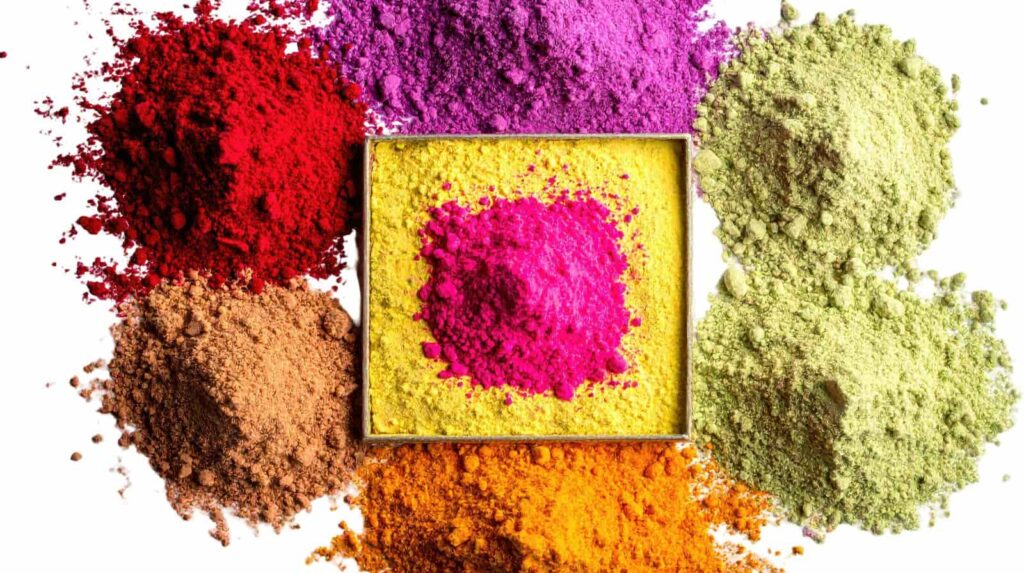
Powder – the professionals’ favourite. Highly concentrated, so you need only a small amount.
Gel – very versatile, but besides the pigment they also contain preservatives, water, glucose, oil and so on, so they are less intense.
Liquid – very diluted and mostly used in an airbrush. They are rarely added directly to preparations.
Classification by source
Natural colourings are obtained by processing foods or minerals rather than by synthesis. Examples include beetroot powder, freeze-dried raspberries, turmeric, saffron, matcha, spinach, chlorophyll, blue spirulina, butterfly pea flower, blueberries and vegetable charcoal. They come with their own challenges: some are heat-sensitive and lose their colour when cooked at the wrong temperature, some leave an aftertaste, and they can’t produce very intense shades.
Synthetic colourings are essentially pure pigment molecules. They contain no water or organic residue that could alter the chemistry of your preparation, they have extreme colouring power and they are fully heat-stable. They are generally neutral in taste, although too much can give a metallic or bitter note.
How much colouring can you use?
Legally, there are maximum permitted doses for each colouring, expressed in mg of colouring per kg of finished product. This information is usually given on the packaging or in the product’s technical data sheet. For colourings without a maximum limit, the term quantum satis is used – meaning as much as is needed to achieve an acceptable colour.
What does azo-free mean?
Azo dyes are a group of synthetic colourings with an “azo” group in their chemical structure. They are the most widely used worldwide because they are cheap and produce very bright colours. However, six azo dyes have been linked to hyperactivity and lack of attention in children: E102 (tartrazine), E104 (quinoline yellow), E110 (sunset yellow), E122 (carmoisine), E124 (ponceau 4R) and E129 (allura red). In the EU, products containing any of these six must carry a warning on the label.
Azo-free colourings are synthetic colourings based on non-azo molecules. They are slightly weaker, but a much better choice for colouring your desserts.
E171 (titanium dioxide) – why it was banned
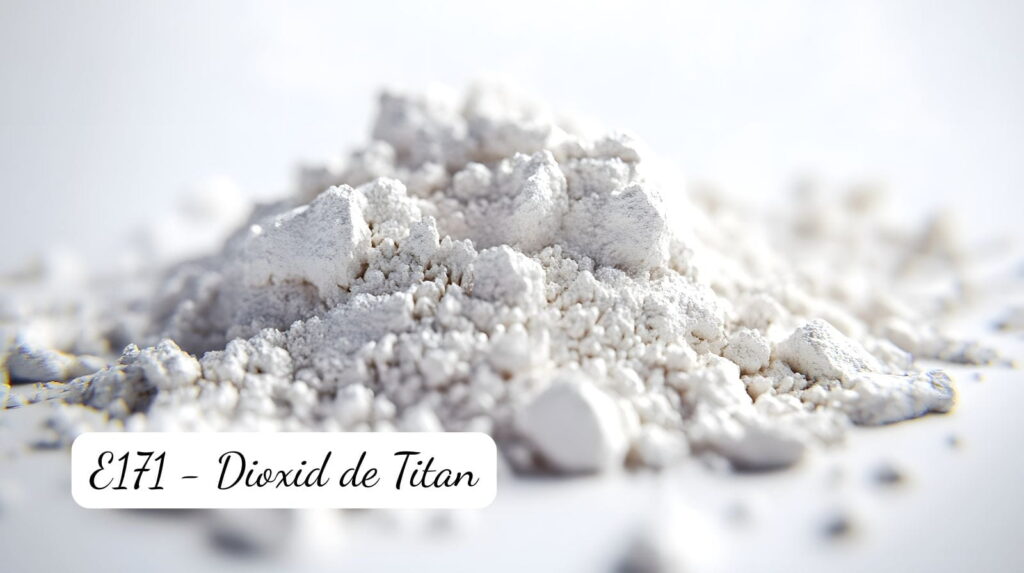
For a long time, E171 was the standard for a pure, bright white in pastry. It was the almost magical ingredient that turned a translucent glaze opaque and snow-white.
E171 is a white mineral pigment, extremely effective at providing opacity. Pastry chefs used it to make mirror glazes opaque and to achieve pure white sugar paste and decorations.
After years of studies, the European Food Safety Authority concluded that E171 could no longer be considered safe as a food additive. The concern is its nanoparticles, which can cross the body’s biological barriers, meaning that genotoxicity – the ability to damage DNA – could not be ruled out. Since 2022, titanium dioxide has been banned as a food additive throughout the EU.
The ban forced producers to find alternatives. Today, calcium carbonate is the most common substitute, although it doesn’t offer the same opacity or whitening power.
Want to put this into practice? Try the Rouge entremet with its velvet finish, or read more in our Pastry Science section.
Want to bake like a pro? Learn professional layered cakes step by step with our online courses and ebooks – from Red Velvet to Caramel Carrot Cake. Browse the courses →